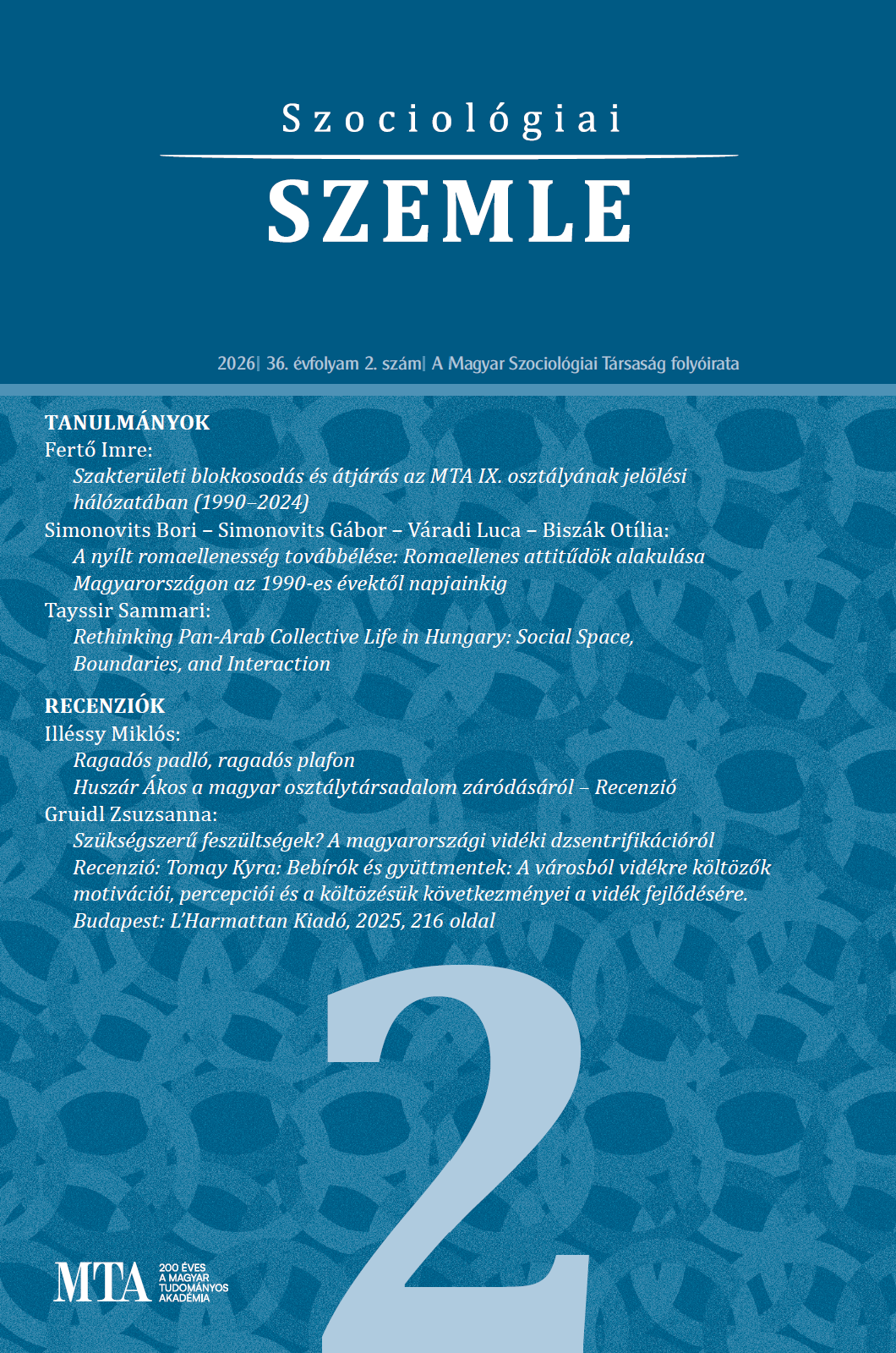
Rethinking Pan-Arab Collective Life in Hungary: Social Space, Boundaries, and Interaction
DOI:
https://doi.org/10.51624/SzocSzemle.23130Keywords:
Pan-Arab social space, migration, social boundaries, cross-national relations, HungaryAbstract
This paper examines how cross-national Pan-Arab social relations are organized in Hungary among individuals who share linguistic and cultural references while differing in national background, migration trajectory, social position, and normative orientation. Drawing on a relational social-space perspective, the study focuses on how proximity, boundaries, and unequal positions are negotiated within this shared environment. The analysis is based on 30 semi-structured interviews conducted between October 2025 and January 2026. The findings show that Pan-Arab relations are structured through different combinations of cultural and linguistic familiarity, normative compatibility, practical accessibility, and social distance. Participants navigate national, regional, and broader Pan-Arab forms of proximity while negotiating differences in values, everyday practices, political orientations, and socioeconomic positions. Cultural familiarity can facilitate interaction while increasing exposure to judgment and social expectations, producing relationships in which relational proximity can coexist with normative distance. The analysis also identifies shifting hierarchies related to linguistic accommodation, socioeconomic resources, migration trajectories, and social evaluation. The study identifies the Pan-Arab level as a significant cross-national scale of migrant social organization and shows how familiarity and internal difference become relationally organized within the Hungarian migration context.
References
Abdelhady, D. – Aly, R. (eds.) (2022): Routledge Handbook on Middle Eastern Diasporas. Routledge. https://doi.org/10.4324/9780429266102
Anthias, F. (2008): Thinking through the lens of translocational positionality: An intersectionality frame for understanding identity and belonging. Translocations: Migration and Social Change, 4(1): 5–20.
Antonsich, M. (2010): Searching for belonging – An analytical framework. Geography Compass, 4(6): 644–659. https://doi.org/10.1111/j.1749-8198.2009.00317.x
Azeredo, R. (2024): The Brazilian diaspora: Intra-community dynamics and differentiating factors among Brazilian migrants worldwide. Sociology Compass, 18(4): e13201. https://doi.org/10.1111/soc4.13201
Barth, F. (ed.) (1969): Ethnic Groups and Boundaries: The Social Organization of Culture Difference. Universitetsforlaget; George Allen & Unwin.
Bauböck, R. – Faist, T. (eds.) (2010): Diaspora and Transnationalism: Concepts, Theories and Methods. Amsterdam University Press. https://doi.org/10.5117/9789089642387
Bilecen, B. – Lubbers, M. J. (2021): The networked character of migration and transnationalism. Global Networks, 21(4): 837–852. https://doi.org/10.1111/glob.12317
Bourdieu, P. (1979): La distinction: Critique sociale du jugement. Les Éditions de Minuit.
Bourdieu, P. (1990): The Logic of Practice. Stanford University Press.
Brubaker, R. (2005): The ‘diaspora’ diaspora. Ethnic and Racial Studies, 28(1): 1–19. https://doi.org/10.1080/0141987042000289997
Delanty, G. (2003): Community. Routledge.
Gallai, S. – Janik, S. (2025): Migráció Magyarországon az EU-csatlakozás óta eltelt időszakban [Hungary and migration after the EU accession]. Századvég, 2024(2): 27–55.
Hachimi, A. (2013): The Maghreb-Mashreq language ideology and the politics of identity in a globalized Arab world. Journal of Sociolinguistics, 17(3): 269–296. https://doi.org/10.1111/josl.12037
Lamont, M. (1992): Money, Morals, and Manners: The Culture of the French and the American Upper-Middle Class. University of Chicago Press. https://doi.org/10.7208/chicago/9780226922591
Lamont, M. – Molnár, V. (2002): The study of boundaries in the social sciences. Annual Review of Sociology, 28: 167–195. https://doi.org/10.1146/annurev.soc.28.110601.141107
Levitt, P. – Jaworsky, B. N. (2007): Transnational migration studies: Past developments and future trends. Annual Review of Sociology, 33: 129–156. https://doi.org/10.1146/annurev.soc.33.040406.131816
Reed-Danahay, D. (2017): Bourdieu, social space, and the nation-state: Implications for migration studies. Sociologica, 11(2). https://doi.org/10.2383/88198
Ryan, L. (2021): Telling network stories: Researching migrants’ changing social relations in places over time. Global Networks, 21(4): 766–782. https://doi.org/10.1111/glob.12295
Salazar, N. B. (2020): On imagination and imaginaries, mobility and immobility: Seeing the forest for the trees. Culture & Psychology, 26(4): 768–777. https://doi.org/10.1177/1354067X20936927
Tönnies, F. (1887/2001): Community and Civil Society. Edited by J. Harris, translated by M. Hollis. Cambridge University Press. https://doi.org/10.1017/CBO9780511816260
Török, I. (2017): Migration patterns and core–periphery relations from the Central and Eastern-European perspective. European Review, 25(3): 388–405. https://doi.org/10.1017/S1062798717000059
Vertovec, S. (2007): Super-diversity and its implications. Ethnic and Racial Studies, 30(6): 1024–1054. https://doi.org/10.1080/01419870701599465
Wimmer, A. (2013): Ethnic Boundary Making: Institutions, Power, Networks. Oxford University Press. https://doi.org/10.1093/acprof:oso/9780199927371.001.0001
Yuval-Davis, N. (2011): The Politics of Belonging: Intersectional Contestations. SAGE. https://doi.org/10.4135/9781446251041